Queuco River (Chile)
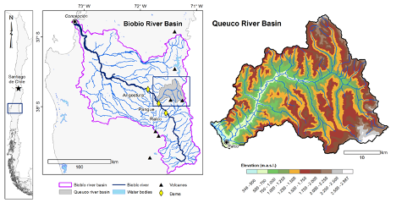
The Queuco River is an Andean tributary of the Biobío river. Its eastern boundary coincides with the international limit between Chile and Argentina. The confluence with the Biobío is in a section located between the Pangue and Angostura dams (see map).
The Biobío watershed is located in a biogeographic transition between central and southern Chile. This river basin hosts high biodiversity, manifested in both terrestrial and freshwater biota, including the highest richness of native fish in Chile (Vila & Habit, 2015) and two endemic species: Trichomycterus chiltoni and Persilia iriwni, both of them endangered (Habit et al., 2020). Another important species is Diplomystes nahuelbutaensis, endemic only to de Biobío and Imperial rivers (Arratia & Quezada, 2017).
The basin altitudinal gradient, varying between 346 and 2,987 m.a.s.l. allows development of diverse vegetational types such as wetland (mallín), low and high grasslands (pampa), mixed native forest, deciduous forest and Araucaria forest (piñalerías).
The physical environment presents steep mountain terrain, where slopes can be greater than 30º in some cases. Volcanoes are important geographical landmarks of great relevance for ecological and cultural history of the basin. There are four nearby volcanoes, Antuco, Callaqui, Copahue and Lonquimay, which have a great importance for the Mapuche-Pewenche world vision and livelihoods.
Aside from the ecological and cultural importance, the Biobío stands out for its enormous hydroelectric potential. This potential begun being studied in the 60’s by ENDESA – back then a public company. During Augusto Pinochet’s dictatorship, many public companies such as ENDESA were privatized. In the 90’s, ENDESA began carrying out this set of mega-dam projects. Since then, the Biobío has become an emblematic basin in Chile for hosting three mega-dams: Pangue (1996); Ralco (2004) and Angostura (2014) (see map).
These projects are a manifestation of the commodification of water and the operation of the market system for water allocation. This is a result of the 1980 Constitution and the 1981 Water Code which legislate access and use of water as private property (Bauer, 2004).
Country: Chile
Region (State): Región del Biobío
Commune (District): Comuna de Alto Biobío (total population of 5923 – 2017 Census)
Population center: Ralco (urban population of 1,094 – 2017 Census)
River length: 75 km
Watershed area: 987 km2
Köppen Climate Classification: Csb Warm temperate, summer dry, warm summer
Source: Andes Mountains. Important features: Callaqui Volcano (3164 m.a.s.l.) and Copahue Volcano (2965 m.a.s.l).
Mean annual precipitation at source: 95 mm
Mouth: Confluence with Biobío River (37º 49” 43’ S, 71º 40” 47’ W, elevation 350 m.a.s.l.)
Mean annual precipitation at mouth: 160 mm
The Queuco River basin is located within the administrative limits of the Alto Biobío Commune, and is contained completely within the Indigenous Development Area (ADI) of Alto Biobío. The principal land cover of the basin is native forest (57%). The low presence of forest plantations (0.8%) stands out considering that the Biobío River basin concentrates the largest amount of forest plantations nationwide. However, sparse exotic-tree plantations were still established encouraged by state subsidies.
In the 2017 census 86% of Alto Biobío population self-identified as Mapuche-Pewenche. The Pewenche culture has a singular variation of mapudungun (Mapuche language) called chedungun. In Alto Bobío, there are eleven Pewenche communities: Callaqui, Pitril, Cauñicú, Malla Malla, Trapa Trapa and Butalelbún along the Queuco River; and El Avellano, Quepuca Ralco, Ralco Lepoy , El Barco and Guallalí along the Biobío main river course.
These communities have suffered a prolonged history of marginalization and diverse forms of violence during colonial and republican times. Their ancestral lands have been occupied and recent recuperation efforts has led to police oppression and has landed many local leaders and traditional authorities in jail. The situation related to water is similar as that of land property: and alarming 99.6% of the registered water rights in the Queuco River do not belong to Pewenche communities and inhabitants.
Major Issues
The before mentioned construction of three mega-dams inundated huge surfaces of native forest and sacred lands of ancestral Pewenche territory (Moraga, 2001; Namuncura, 1999). With the construction of the Angostura Dam (2014), the Queuco river became isolated from the rest of the fluvial network. Today the ecological and social impacts of these types of mega projects have been widely reported on a global scale.
One principal impact resulting from these dams has to do with the hydropeaking operations which severely alter natural flow regime and thus the availability and quality of fluvial habitat (García et al., 2011). Impact on fish communities has been documented for the Biobío River (Habit et al., 2018). Percilia irwini, which is endemic to the Biobío River, has shown severe effects in a very short period of time since the operation of Ralco and Pangue dams. Valenzuela et al. (2019) detected population extirpation in two river reaches limited by upstream and downstream dams.
Despite this scientific evidence, Chilean economic development model seems not to learn the lessons from hydroelectric development (Nelson, 2013). The Chilean State is pushing forward a nationwide energy strategy that promotes hydroelectricity as “clean” renewable energy (Pacheco, 2018). Through this and other policies, the Chilean State continues to evidence a stance of acculturation towards indigenous peoples, far from recognizing their cultures, rights and unique livelihoods, it insists on integrating them to the hegemonic development model (Zuleta, 2018).
As one of the few remaining free-flowing tributary, the Queuco River is of enormous importance as it can act as facilitators of source-sink population dynamics for fish species (Marques et al., 2018). This characteristic should be included in future agendas for environmental management programs as it would allow to balance human activities and the conservation of fish diversity.
Research Questions:
- Considering water availability in climate crisis scenarios and local cultural context, what aspects of public policies should be developed/encouraged?
- What has been the relationship in the historical trajectory of land property and water rights in the Queuco river basin?
- What are the main social-ecological conflicts in the Queuco river basin and its surroundings today?
- What is the normative framework and institutional performance been in relation to river management, indigenous peoples and ancestral waters?
- Who owns the water? (i.e. Who is holder of water rights and what are their relationships to Pewenche territory in Alto Biobío)
Skillsets and experience (desired): Advanced spoken and written Spanish; public policy analysis; environmental impact analysis; knowledge of fluvial ecosystems functioning; understanding of social-ecosystems; experience with indigenous people through research or professional work; and experience with citizen science and community monitoring.
References Cited
Arratia, G., & Quezada, C. (2017). Understanding morphological variability in a taxonomic context in Chilean diplomystids (Teleostei: Siluriformes), including the description of a new species. PeerJ, 2017(2). https://doi.org/10.7717/peerj.2991
Bauer, C. (2004). Siren song: Chilean water law as a model for international reform. Resources for the Future. https://doi.org/https://doi.org/10.4324/9781936331062
García, A., Jorde, K., Habit, E., Caamaño, D., & Parra, O. (2011). Downstream environmental effects of dam operations: Changes in habitat quality for native fish species. River Research and Applications, 27(3), 312–327. https://doi.org/10.1002/rra.1358
Habit, E., Diaz, G., & Manosalva, A. (2020). Peces nativos del río Biobío: 30 años después. In EULA-Chile Centro de Ciencias Ambientales. Evolución y perspectivas a 30 años de su creación. (Vol. In Print). Concepción, Chile.
Habit, E., García, A., Díaz, G., Arriagada, P., Link, O., Parra, O., & Thoms, M. (2018). River science and management issues in Chile: Hydropower development and native fish communities. River Research and Applications, (May), 1–11. https://doi.org/10.1002/rra.3374
Marques, H., Dias, J. H. P., Perbiche-Neves, G., Kashiwaqui, E. A. L., & Ramos, I. P. (2018). Importance of dam-free tributaries for conserving fish biodiversity in Neotropical reservoirs. Biological Conservation, 224(May), 347–354. https://doi.org/10.1016/j.biocon.2018.05.027
Moraga, J. (2001). Aguas Turbias: La central hidroeléctrica Ralco en el Alto Bío Bío (1o). Santiago: LOM Ediciones.
Namuncura, D. (1999). Ralco: ¿Represa o pobreza? LOM Ediciones.
Nelson, M. (2013). Viewpoint – Fifty years of hydroelectric development in chile: A history of unlearned lessons. Water Alternatives, 6(2), 195–206.
Pacheco, M. (2018). Prólogo. In M. Pacheco (Ed.), Revolución Energética en Chile. Santiago, Chile.
Valenzuela, F., McCracken, G. R., Manosalva, A., Habit, E., & Ruzzante, D. E. (2019). Human-induced habitat fragmentation effects on connectivity, diversity, and population persistence of an endemic fish, Percilia irwini, in the Biobío River basin (Chile). Evolutionary Applications, (October), 1–14. https://doi.org/10.1111/eva.12901
Vila, I., & Habit, E. (2015). Current situation of the fish fauna in the Mediterranean region of Andean river systems in Chile. Fishes in Mediterranean Environments, (2), 1–19.
Zuleta, J. (2018). Integración de los Pueblos Indígenas en la Política Energética. In M. Pacheco (Ed.), Revolución Energética en Chile (pp. 383–392). Santiago, Chile.