Pathways Program
Welcome to Partnerships Along the Headwaters of the Americas for Young Scientists (Pathways) Program!
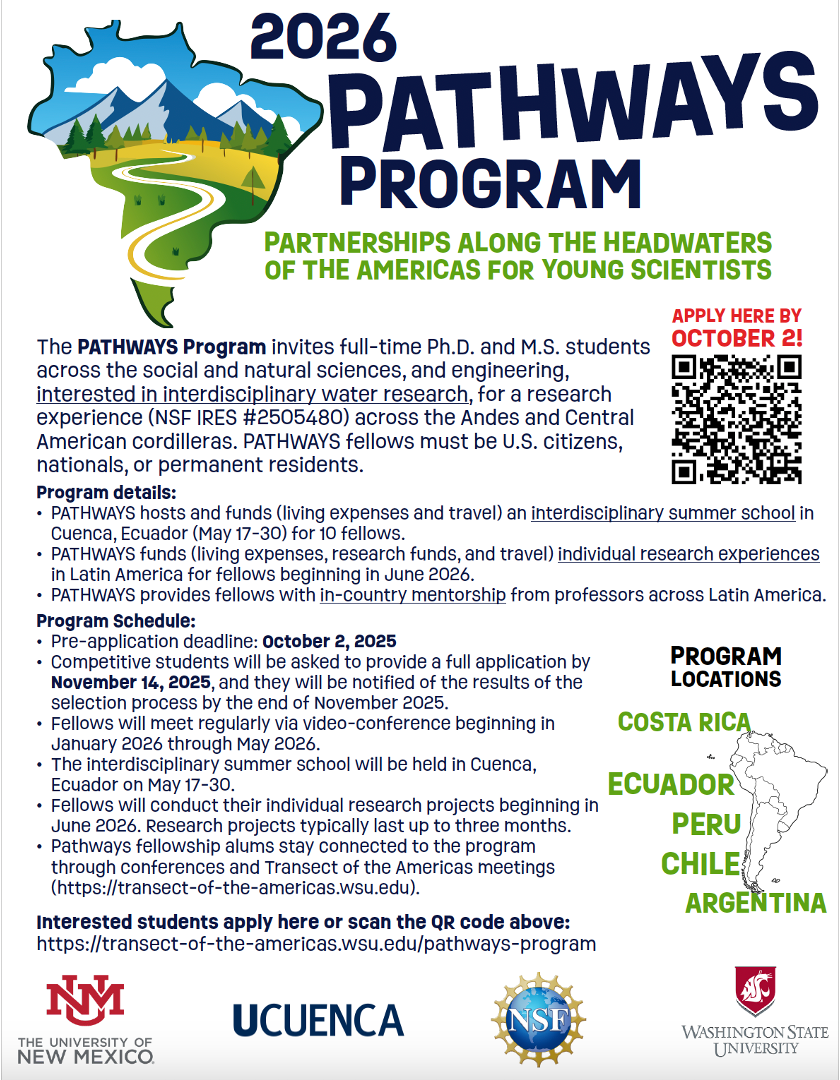
As part of the National Science Foundation’s International Research Experience for Students, Washington State University and the University of New Mexico are seeking MS and PhD students to conduct research as part of the Transect of the Americas research network in Central and South America.
This program leverages our network of research sites and an interdisciplinary team of collaborators from twelve institutions in six countries stretching from Alberta, Canada to Patagonia, Chile, and Argentina. Each country in our Network contains one or more research sites that can be studied as a social-ecological system (SES) including both the headwaters (i.e., natural watersheds or hydro-climatic systems) and the downstream water use systems and the embedded social systems. Collectively, we refer to these social-ecological systems as headwater dependent systems (HDSs). Our network studies the changing hydro-climatic patterns and other concurrent internal and external stressors presented by changing societies to better understand what adaptation strategies to short- and long-term challenges may be most successful.
The Pathways Program offers high quality student engagement in HDS research across our Network using a novel international research experience model. The program is designed to be flexible in order to meet the needs and unique circumstances of the graduate student, their advisor, the international mentor, and the mission of our research network. If you are a student interested in this program, please read the below information and fill our our Pre-Application form (located at the bottom of this page).
The Pathways Program is a 12 month program that brings together a small cohort of students and faculty to explore interdisciplinary issues in HDS systems in Central and South America. Students accepted into the program participate in skills-building training and hands-on experience through a series of structured elements, including:
Spring Training (Jan – April): Online course designed to build familiarity with the Pathways Program including; developing basic literacy on the principles of HDS research and training; establishing initial connections within the cohort; acquiring basic cultural and language skills (as needed); and initiating interactions with host mentors.
Summer School in Cuenca, Ecuador (May): This is a two-week, in-person instructional summer school held in Cuenca, Ecuador. The summer school will be conducted in the context of real-world water governance challenges in Cuenca, Ecuador, and is a central component of the program. It aims to help students build and integrate interdisciplinary, international, and inter-organizational research knowledge. The summer school will use students’ theoretical knowledge of HDS systems and research methods acquired during the spring training and put them into practice in a safe international space. The summer school is mandatory for all Pathways US students.
International research experience (May – August): After the summer school, US students will travel directly to their chosen host institution to perform the research activities outlined in the proposals they prepared during the application to Pathways. Students are expected to travel between June and August as this time frame is less likely to affect students’ time to degree. Students will end their experience with a personalized check-up to discuss how the experience went and assess with re-integration.
Fall synthesis (Sept – Dec): A series of online meetings will be held for returning students to share their research experience, compare their experience with other students, and rigorously make cross-case study comparisons. Each Pathways cohort experience will culminate in a final online meeting with Transect members (including previous cohorts) in November. Each student will present their research and begin discussion with individual Transect researchers.
December and beyond: Student cohorts will be encouraged to remain actively engaged in the Transect community through quarterly webinars, annual meetings, presence on our RCN web site, and serving as mentors for future students.
We seek students with aptitude in interdisciplinary research and backgrounds in hydrologic science, ecology, and social science. Students must be full-time graduate students (working towards a thesis/dissertation and not yet graduated), and must be citizens, nationals, or permanent residents of the United States.
The Pathways package will include 1) travel expenses (subject to university and NSF Policies) to/from the summer school and to the research site and back to the US; 2) subsistence stipend of $1,500/month for international research experiences of 2-10 weeks; and 3) partial funding for research expenses.
Contacts
If you have questions about the program, please contact Dr. Alex Fremier at Washington State University (alex.fremier@wsu.edu) or Dr. Ben Warner at the University of New Mexico (bpwarner@unm.edu).